
Series 06
eTIMS & Taxes
Series 06
eTIMS & Taxes
Tax & compliance
Taxes for Mini-Marts in Kenya: The Complete eTIMS & KRA Guide
Everything a mini-mart owner in Kenya needs to know about tax — eTIMS, VAT, turnover tax, income tax, PAYE, excise, records, and penalties — and how the right till keeps it manageable.
25 August 2026 · Kiosk
Running a mini-mart in Kenya means juggling rent, suppliers, stock, and staff — and somewhere in the middle of all of it, the tax man. It's tempting to treat taxation as a month-end mystery best left to an accountant, but for a shop owner the basics are surprisingly small: a handful of taxes, a few deadlines, and one system — eTIMS — that sits underneath all of it.
This is the pillar guide for the whole series. It maps out every tax a Kenyan mini-mart owner deals with, explains what each one means in plain language, and points you to a dedicated guide for each topic. Read the sections that apply to your shop, then follow the links to go deeper.
The tax map for a Kenyan mini-mart
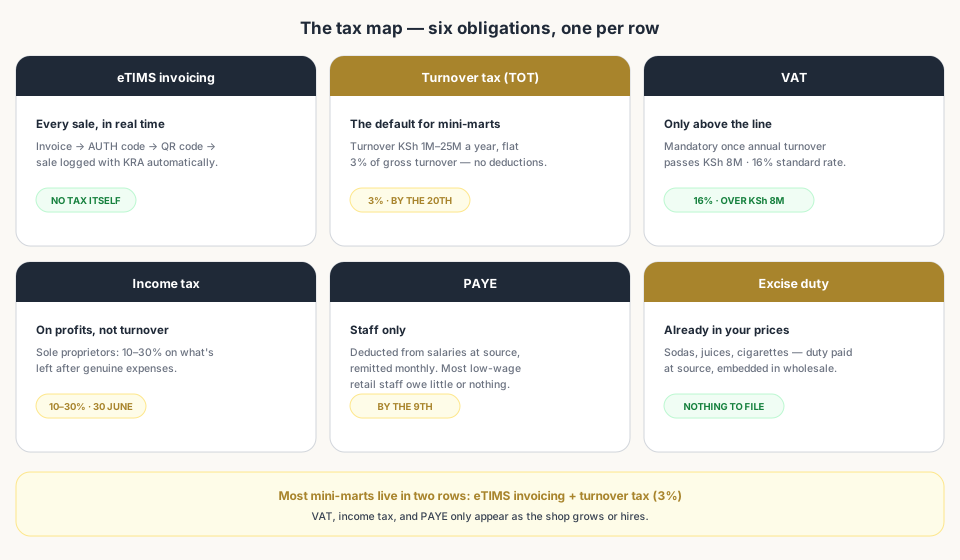
Before we go deep, here's the whole landscape on one page. Every row is its own guide in this series:
| Tax / obligation | Who it applies to | Rate | When it's due |
|---|---|---|---|
| eTIMS invoicing | All businesses issuing invoices under KRA rules | No tax — it's the invoice system itself | Every sale, in real time |
| Turnover tax (TOT) | Shops with KSh 1–25M annual turnover | 3% of gross turnover | Monthly, by the 20th of the next month |
| VAT | Only once annual turnover exceeds KSh 8M | 16% standard (some goods zero-rated or exempt) | Monthly, by the 20th of the next month |
| Income tax | Sole proprietors / business owners | 10–30% on profits | Annual return by 30 June |
| PAYE | Only if you employ staff | Deducted from salaries at source | Monthly, by the 9th of the next month |
| Excise duty | Mostly embedded in wholesale prices | Varies by product | Paid to suppliers; nothing extra to file |
1. eTIMS: the system under everything
eTIMS — KRA's Electronic Tax Invoice Management System — is how KRA now watches retail sales. You generate an invoice for a sale, KRA issues an authorization (AUTH) code for it in real time, the invoice carries a QR code, and the sale lands in KRA's records. It replaces the old ETR machines and it's how the taxman can see your turnover without ever visiting your shop.
You can use eTIMS through KRA's web portal, the eTIMS mobile app, an offline desktop app, or — the option that matters for a shop — through a POS system that issues eTIMS-ready invoices automatically. Every invoice your till generates can carry the authorization code and sync to KRA without anyone retyping anything.
- What Is eTIMS in Kenya? The System ExplainedHow eTIMS works, who must use it, and the four ways to run it.
- How to Register for eTIMS in Kenya: Step-by-StepFrom iTax login to your first authorized invoice, same day.
2. Turnover tax (TOT): the default for most mini-marts
If your mini-mart's annual turnover sits between KSh 1 million and KSh 25 million — which describes the vast majority of Kenyan mini-marts — turnover tax is likely your main income-related tax. It's a flat 3% of gross turnover, filed monthly through iTax by the 20th of the following month. No deductions, no expense schedules, no arguments: 3% of what you actually sold.
The trade-off is that TOT is charged on turnover, not profit — so even a thin-margin month still owes its 3%. That's exactly why the shops that thrive keep their margins healthy and their records clean, rather than trying to make the numbers disappear.
3. VAT: only once you cross the line
VAT is the tax most shop owners worry about — and for most mini-marts, it never actually applies. VAT registration becomes mandatory only when annual taxable turnover passes KSh 8 million (raised from KSh 5 million by the Finance Act 2023). Below that, you don't charge VAT to customers, and you don't file VAT returns. Above it, you charge 16% on taxable sales and file monthly by the 20th.
There's a nuance that suits mini-marts: many staples — maize flour, milk, unprocessed foods — are zero-rated or exempt, so a shop heavy on essentials may owe very little output VAT even after crossing the threshold. If you're edging toward KSh 8 million, read the VAT guide before you get there, not after.
4. Income tax & PAYE: your profits and your staff
Sole proprietors pay income tax on their business profits at the personal rates: 10% up to KSh 288,000 a year, 25% up to KSh 388,000, and 30% above that. The annual return goes in through iTax by 30 June. If you employ cashiers or shop attendants, you're also an employer: register for PAYE, deduct it from salaries, and remit it by the 9th of every month.
The golden rule that keeps income tax small: pay it on profit, not turnover. Every legitimate business expense — stock, rent, power, transport, staff wages — reduces your taxable profit, but only if you have the records to prove it. A till that keeps your sales and stock honest is the same tool that keeps your tax honest.
5. Excise duty: usually not your problem to file
Excise duty is a tax on specific goods — sweetened sodas and juices, alcohol, cigarettes, and a few others. Here's what most mini-mart owners need to know: by the time those goods reach your shelf, the excise duty is already baked into the wholesale price you paid. You don't charge it separately at the till, and you don't register as an excise licensee unless you manufacture or import the goods yourself.
The one real risk for a shop is stock that arrived without duty paid — cheap cigarettes or drinks that somehow cost far less than the market rate. That's not a bargain, that's a liability. If a price is too good to be true, it usually means the duty isn't in it.
6. Records and penalties: what KRA can demand
KRA can ask to see your records for up to five years — sales, purchases, invoices, stock movements, and payroll. If your records are an exercise book updated from memory, that's a stressful conversation waiting to happen. If they're generated automatically by your till, it's a file you hand over.
The penalties for getting it wrong are real: monthly penalties for late returns, interest of 1% per month on unpaid tax, and fines of up to KSh 1 million with possible imprisonment for serious eTIMS violations — like failing to issue electronic invoices at all. None of it is worth the shortcut.
7. The one thing that makes all of this easier
Notice a pattern? Every tax on this list gets harder the further your records are from reality. The shops that sail through tax season aren't the ones with better accountants — they're the ones whose till generates the paper trail for every sale, automatically, without anyone reconstructing it at month end.
Kiosk.ke is built on that idea: a point-of-sale that scans products, takes M-Pesa, tracks stock, and keeps every invoice ready for eTIMS reporting — so when your accountant asks for numbers, they're already there, accurate, dated, and reconciled with what's actually on your shelves. eTIMS compliance becomes a background process instead of a monthly archaeology project.
- eTIMS and Your POS: How the Right Till Keeps You KRA-ReadyHow POS/eTIMS integration works and what to look for in a till.
- Set Up a POS in Kenya in 30 MinutesTill, storefront, M-Pesa, and eTIMS-ready invoices in one afternoon.
Your tax checklist as a mini-mart owner
- Register your business and get your KRA PIN attached to it, not just to you.
- Onboard to eTIMS — ideally through a POS that issues compliant invoices automatically.
- Know your tax type: turnover tax (under KSh 25M), income tax on profits, or VAT (over KSh 8M).
- Put the deadlines in your calendar: 20th monthly for TOT/VAT, 9th monthly for PAYE, 30 June for the annual return.
- Keep five years of records — and let your till generate them for you.
- Never buy duty-suspicious stock. A cheap cigarette is an expensive liability.
Keep reading
- What Is eTIMS in Kenya? The System ExplainedStart here if eTIMS still feels like alphabet soup.
- Turnover Tax (TOT) in Kenya: Who Pays, the Rate, and How to FileThe tax most mini-marts actually pay, in plain language.
- VAT for Small Businesses in Kenya: Threshold, Rates & FilingEverything you need before (and after) KSh 8 million.
- eTIMS and Your POS: How the Right Till Keeps You KRA-ReadyWhy compliance gets easy when your till does the work.
- How to Start a Mini-Mart in Kenya: From Idea to Opening DayCapital, location, licenses, first stock, and the till that keeps it honest.
Frequently asked questions
Which taxes does a mini-mart in Kenya actually pay?
Most mini-marts deal with four: eTIMS-compliant invoicing (KRA's electronic invoice system, now mandatory in practice for VAT-registered businesses), turnover tax (3% of gross turnover for businesses earning KSh 1–25 million a year) or income tax on profits, VAT only once annual turnover passes KSh 8 million, and PAYE if you employ staff. Excise duty is usually already embedded in the wholesale price of goods like sodas and juices.
Is eTIMS mandatory for small shops in Kenya?
eTIMS is KRA's electronic tax invoice management system, and invoicing through it is now mandatory for businesses that must invoice for VAT. In practice KRA has been enforcing eTIMS across retail, and a modern POS that issues invoices and keeps them ready for eTIMS reporting is the painless way to stay compliant. Confirm your exact obligations with KRA or your accountant.
How much tax does a small shop pay in Kenya?
A mini-mart turning over KSh 1–25 million a year typically pays turnover tax at 3% of gross turnover — roughly KSh 3,000 for every KSh 100,000 of sales, before any expenses are considered. Shops above the VAT threshold (KSh 8 million annual turnover) pay 16% VAT on taxable supplies instead, and sole proprietors pay income tax on their profits at rates of 10–30%.
What happens if I don't file my taxes on time in Kenya?
Late filing attracts monthly penalties, unpaid tax accrues interest at 1% per month, and serious eTIMS violations (such as failing to issue electronic invoices) can attract fines of up to KSh 1 million and imprisonment under the Tax Procedures Act. The practical fix is software that generates the right records for every sale automatically — so month end is a review, not a reconstruction.
More from this series
- Tax & complianceWhat Is eTIMS in Kenya? The System ExplainedeTIMS — KRA's Electronic Tax Invoice Management System — explained for shop owners: how invoices get authorized, who must use it, and the four ways to run it.
- Tax & complianceHow to Register for eTIMS in Kenya: Step-by-StepHow to onboard to eTIMS in Kenya — the iTax steps, the four onboarding methods, what a USB token is for, and how a POS handles the whole thing for you.
- Tax & complianceVAT for Small Businesses in Kenya: Threshold, Rates & FilingWhen VAT registration is compulsory in Kenya, what the 16% applies to, why staples often owe little VAT, and the monthly return routine — explained for shop owners.
- Tax & complianceTurnover Tax (TOT) in Kenya: Who Pays, the Rate, and How to FileTurnover tax explained for Kenyan shop owners — the KSh 1–25 million range, the 3% rate, the monthly filing routine, and how TOT relates to income tax and VAT.
- Tax & complianceIncome Tax for Shop Owners in Kenya: Sole Proprietors, PAYE & FilingHow income tax works for Kenyan shop owners — the 10/25/30% tax bands, what counts as a deductible expense, PAYE for staff, and the 30 June annual return.
- Tax & complianceExcise Duty and Retailers in Kenya: What Mini-Marts Actually Deal WithExcise duty for Kenyan mini-marts, explained: what's excisable, why the duty is already in your wholesale price, who has to register as a licensee, and the duty-unpaid trap to avoid.
- Tax & complianceRecord-Keeping and KRA Penalties: What Kenyan Shop Owners Must Keep (and Avoid)What records a Kenyan shop must keep and for how long, the KRA penalty schedule for late returns and eTIMS violations, and why automatic records beat reconstruction.
- Tax & complianceeTIMS and Your POS: How the Right Till Keeps You KRA-ReadyHow eTIMS/POS integration works in Kenya — AUTH codes per sale, offline queues, OSCU/VSCU, and what to look for in a till that makes KRA compliance automatic.
- Tax & complianceHow to File Tax Returns on iTax: A Walkthrough for Shop OwnersFiling TOT, VAT, PAYE, and the annual return on iTax, step by step — the login, the forms, the deadlines, and the mistakes that trigger penalties.
- Tax & complianceKRA Audits for Small Businesses: What Triggers One and How to PrepareWhat a KRA audit looks like for a mini-mart, what usually triggers one, and the five documents you'll be asked for first.
- Getting startedSet Up a POS in Kenya in 30 MinutesHow to set up a POS in Kenya in 30 minutes — create your account, add products, take M-Pesa payments, and stay eTIMS-ready with KRA. No IT project required.
- Getting startedHow to Start a Mini-Mart in Kenya: From Idea to Opening DayHow to start a mini-mart in Kenya — capital, location, licenses, first stock, and the till that keeps it honest. A step-by-step plan from idea to opening day.
- GrowthHow to Grow a Mini-Mart in Kenya: From One Shop to a Real BusinessPractical steps to move a Kenyan mini-mart from surviving to scaling — compliance, stock control, M-Pesa, digital presence, reinvestment, and knowing when to open a second branch.
- RankingsTop 10 POS Systems in Kenya (2026) — Ranked & ComparedBest POS systems in Kenya for 2026, ranked on setup speed, native M-Pesa, eTIMS readiness, and shop-floor fit. Compare Kiosk.ke, Odoo, SimbaPOS, Tiwi, and more.
Ready for a POS built for Kenya?
Start free on Kiosk.ke — barcode POS, native M-Pesa STK, offline sales, and an online storefront from one stock count.