
Series 06
eTIMS & Taxes
Series 06
eTIMS & Taxes
Tax & compliance
VAT for Small Businesses in Kenya: Threshold, Rates & Filing
When VAT registration is compulsory in Kenya, what the 16% applies to, why staples often owe little VAT, and the monthly return routine — explained for shop owners.
25 August 2026 · Kiosk
VAT is the tax every shop owner has heard horror stories about — and the one most mini-marts will never actually pay. The trick is knowing where the line is, what sits on either side of it, and what changes the day you cross it.
The line: KSh 8 million of annual turnover
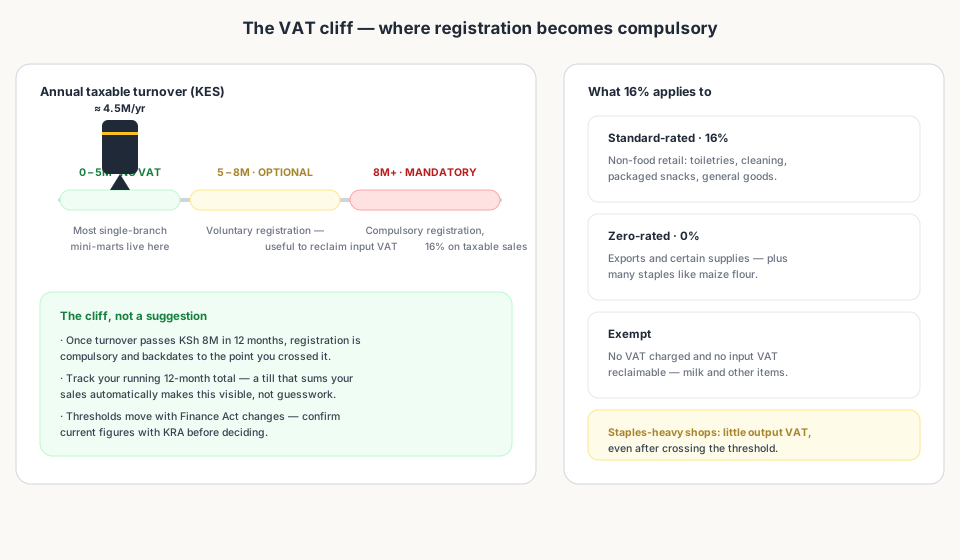
VAT registration in Kenya is compulsory once your taxable turnover exceeds KSh 8 million in a year — raised from KSh 5 million by the Finance Act 2023. Below that line, you are not a VAT-registered business: you don't charge customers 16%, and you don't file VAT returns. You keep invoicing under eTIMS, but VAT itself stays off your plate.
Voluntary registration is available from KSh 5 million — sometimes worth taking if you buy a lot of taxable stock, because it lets you reclaim the input VAT on those purchases. For most mini-marts, staying under the line and out of the VAT machinery is the simpler, better answer.
What 16% applies to (and what it doesn't)
- Standard-rated (16%): most non-food goods and general retail items — toiletries, cleaning products, packaged snacks, drinks that aren't zero-rated.
- Zero-rated (0%): exports and certain supplies, plus many basic foodstuffs such as maize flour and other staples.
- Exempt: certain goods and services where no VAT is charged and no input VAT can be reclaimed — milk and other exempt items in the schedule.
The practical consequence for a mini-mart: a shop whose sales are mostly staples — flour, sugar, milk, cooking oil — has very little output VAT even after crossing the threshold, because those goods carry little or no VAT. The liability concentrates on the discretionary shelf: sodas, snacks, toiletries, and the like.
The monthly routine once you're registered
- Charge 16% VAT on taxable sales — the POS should compute this line automatically per item.
- Collect the input VAT from your suppliers' invoices on taxable purchases.
- File the VAT return on iTax by the 20th of the following month, and pay any balance the same day.
- Keep every invoice eTIMS-compliant — KRA's system is exactly how they verify what you declare.
Why your till matters for VAT
A VAT return is only as good as the invoices behind it, and invoices are only as good as the sales that produced them. A till that generates an eTIMS-compliant invoice per sale, tracks tax per item, and hands your accountant a clean monthly summary turns VAT month from a reconstruction into a review.
- Turnover Tax (TOT) in Kenya: Who Pays, the Rate, and How to FileThe tax that applies below the VAT threshold.
- Taxes for Mini-Marts in Kenya: The Complete eTIMS & KRA GuideThe pillar guide — every tax mapped in one place.
Frequently asked questions
Do mini-marts in Kenya pay VAT?
Only if annual taxable turnover exceeds KSh 8 million (the compulsory registration threshold, raised from KSh 5 million by the Finance Act 2023). Below that you don't charge VAT, and you don't file VAT returns. Most single-branch mini-marts sit below the threshold — but the moment you approach it, registration is compulsory.
What is the VAT rate in Kenya?
The standard rate is 16%. Some supplies are zero-rated (0%) and some are exempt. For a mini-mart the important nuance is that many basic foodstuffs — maize flour, milk, and other staples — are zero-rated or exempt, so even a VAT-registered shop selling mostly essentials may owe very little output VAT.
When must I register for VAT in Kenya?
Registration is compulsory once your taxable turnover exceeds KSh 8 million in a 12-month period. You can also register voluntarily once turnover passes KSh 5 million — useful if you want to reclaim input VAT on big purchases. Confirm the current thresholds with KRA, as Finance Act changes can move them.
How do I file VAT returns in Kenya?
VAT returns are filed monthly through iTax by the 20th of the following month, and any tax due is paid the same day. Registered businesses also charge 16% on taxable sales, reclaim input VAT on purchases, and must keep eTIMS-compliant invoices as the supporting paper trail.
Related articles
- Tax & complianceTaxes for Mini-Marts in Kenya: The Complete eTIMS & KRA GuideEverything a mini-mart owner in Kenya needs to know about tax — eTIMS, VAT, turnover tax, income tax, PAYE, excise, records, and penalties — and how the right till keeps it manageable.
- Tax & complianceTurnover Tax (TOT) in Kenya: Who Pays, the Rate, and How to FileTurnover tax explained for Kenyan shop owners — the KSh 1–25 million range, the 3% rate, the monthly filing routine, and how TOT relates to income tax and VAT.
- Tax & complianceWhat Is eTIMS in Kenya? The System ExplainedeTIMS — KRA's Electronic Tax Invoice Management System — explained for shop owners: how invoices get authorized, who must use it, and the four ways to run it.
- Tax & complianceRecord-Keeping and KRA Penalties: What Kenyan Shop Owners Must Keep (and Avoid)What records a Kenyan shop must keep and for how long, the KRA penalty schedule for late returns and eTIMS violations, and why automatic records beat reconstruction.
- Tax & complianceIncome Tax for Shop Owners in Kenya: Sole Proprietors, PAYE & FilingHow income tax works for Kenyan shop owners — the 10/25/30% tax bands, what counts as a deductible expense, PAYE for staff, and the 30 June annual return.
Ready for a POS built for Kenya?
Start free on Kiosk.ke — barcode POS, native M-Pesa STK, offline sales, and an online storefront from one stock count.