
Series 06
eTIMS & Taxes
Series 06
eTIMS & Taxes
Tax & compliance
Record-Keeping and KRA Penalties: What Kenyan Shop Owners Must Keep (and Avoid)
What records a Kenyan shop must keep and for how long, the KRA penalty schedule for late returns and eTIMS violations, and why automatic records beat reconstruction.
25 August 2026 · Kiosk
Tax enforcement in Kenya doesn't start with an audit. It starts with records — what you have, whether they're real, and whether they match. For a mini-mart, the entire tax relationship with KRA comes down to one question: can you show what you sold, and what you bought, in a way that adds up?
The five-year rule
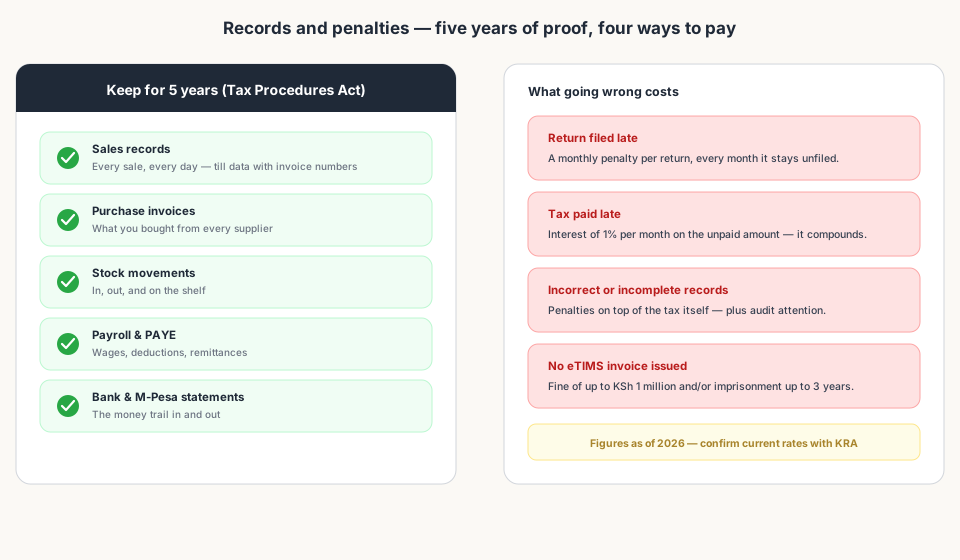
The Tax Procedures Act requires you to keep records for five years. For a shop that means:
- Sales records — every sale, every day, with the till data to back it.
- Purchase invoices — what you bought from every supplier, with their receipts.
- Stock records — what came in, what went out, what's on the shelf.
- Payroll records — wages, PAYE deductions, and remittances.
- Bank statements and payment records — the money trail in and out.
The penalty schedule, in plain language
| Situation | What KRA can charge |
|---|---|
| Return filed late | Monthly penalty per return until filed |
| Tax paid late | Interest of 1% per month on the unpaid amount |
| Incorrect or incomplete records | Penalties on top of the tax itself, plus audit attention |
| Failure to issue an eTIMS invoice | Fine of up to KSh 1 million and/or imprisonment up to 3 years |
What actually triggers an audit
KRA's systems now see your sales through eTIMS before you ever file a return. When your declared numbers don't match what your invoices show — or when your stock purchases can't plausibly produce the sales you declare — that's when the questions start. The shops that get audited aren't the big ones; they're the inconsistent ones.
Why the till is the cheapest insurance
Every record on that five-year list is generated automatically by a modern POS: sales with invoice numbers, stock movements per item, and totals that reconcile with your bank and M-Pesa. The shop that reconstructs records from memory at audit time is doing archaeology under pressure. The shop with a till is printing a report.
- What Is eTIMS in Kenya? The System ExplainedWhy your invoices are visible to KRA in real time.
- Turnover Tax (TOT) in Kenya: Who Pays, the Rate, and How to FileThe 3% monthly routine your records feed into.
- Taxes for Mini-Marts in Kenya: The Complete eTIMS & KRA GuideThe pillar guide — every tax mapped in one place.
Frequently asked questions
How long must I keep business records in Kenya?
Five years, under the Tax Procedures Act. That covers sales records, purchase invoices, stock movements, payroll, and bank statements. KRA can ask for them when reviewing or auditing your returns — and five years of exercise-book scribbles is a hard ask, while five years of till-generated records is a folder.
What happens if I file my tax return late in Kenya?
Late filing attracts a monthly penalty — the amount depends on the tax type and period — and unpaid tax attracts interest at 1% per month. The longer it runs, the bigger the pile. Filing something accurate late is always cheaper than filing nothing.
What is the penalty for not using eTIMS in Kenya?
Under the Tax Procedures Act as amended, failing to issue an electronic tax invoice is a serious offense, carrying fines of up to KSh 1 million and imprisonment of up to three years. Enforcement has focused on making eTIMS the default way to invoice — which is why the automatic invoice from your till is the safe route.
What triggers a KRA audit of a small shop?
Inconsistencies usually do: returns that don't match your eTIMS invoice data, sales that contradict your stock purchases, or expenses that outgrow your declared turnover. A shop whose till data, stock, and returns all agree is a very boring audit target — which is exactly the outcome you want.
Related articles
- Tax & complianceTaxes for Mini-Marts in Kenya: The Complete eTIMS & KRA GuideEverything a mini-mart owner in Kenya needs to know about tax — eTIMS, VAT, turnover tax, income tax, PAYE, excise, records, and penalties — and how the right till keeps it manageable.
- Tax & complianceWhat Is eTIMS in Kenya? The System ExplainedeTIMS — KRA's Electronic Tax Invoice Management System — explained for shop owners: how invoices get authorized, who must use it, and the four ways to run it.
- Tax & complianceHow to Register for eTIMS in Kenya: Step-by-StepHow to onboard to eTIMS in Kenya — the iTax steps, the four onboarding methods, what a USB token is for, and how a POS handles the whole thing for you.
- Tax & complianceTurnover Tax (TOT) in Kenya: Who Pays, the Rate, and How to FileTurnover tax explained for Kenyan shop owners — the KSh 1–25 million range, the 3% rate, the monthly filing routine, and how TOT relates to income tax and VAT.
- Tax & complianceVAT for Small Businesses in Kenya: Threshold, Rates & FilingWhen VAT registration is compulsory in Kenya, what the 16% applies to, why staples often owe little VAT, and the monthly return routine — explained for shop owners.
- Tax & complianceIncome Tax for Shop Owners in Kenya: Sole Proprietors, PAYE & FilingHow income tax works for Kenyan shop owners — the 10/25/30% tax bands, what counts as a deductible expense, PAYE for staff, and the 30 June annual return.
Ready for a POS built for Kenya?
Start free on Kiosk.ke — barcode POS, native M-Pesa STK, offline sales, and an online storefront from one stock count.