
Series 06
eTIMS & Taxes
Series 06
eTIMS & Taxes
Tax & compliance
Income Tax for Shop Owners in Kenya: Sole Proprietors, PAYE & Filing
How income tax works for Kenyan shop owners — the 10/25/30% tax bands, what counts as a deductible expense, PAYE for staff, and the 30 June annual return.
25 August 2026 · Kiosk
Income tax is the tax on what you actually keep — your profit — and for a shop owner it comes in two flavours: the tax on your own business income, and PAYE for anyone on your payroll. Both are simpler than they sound, and both get dramatically easier when your records are real.
Sole proprietors pay tax on profit, at personal rates
Most mini-marts are sole proprietorships, and Kenya taxes a sole proprietor's business income at the same rates as personal income. For a year of profits:
| Annual taxable income | Rate |
|---|---|
| Up to KSh 288,000 | 10% |
| KSh 288,001 – 388,000 | 25% |
| Above KSh 388,000 | 30% |
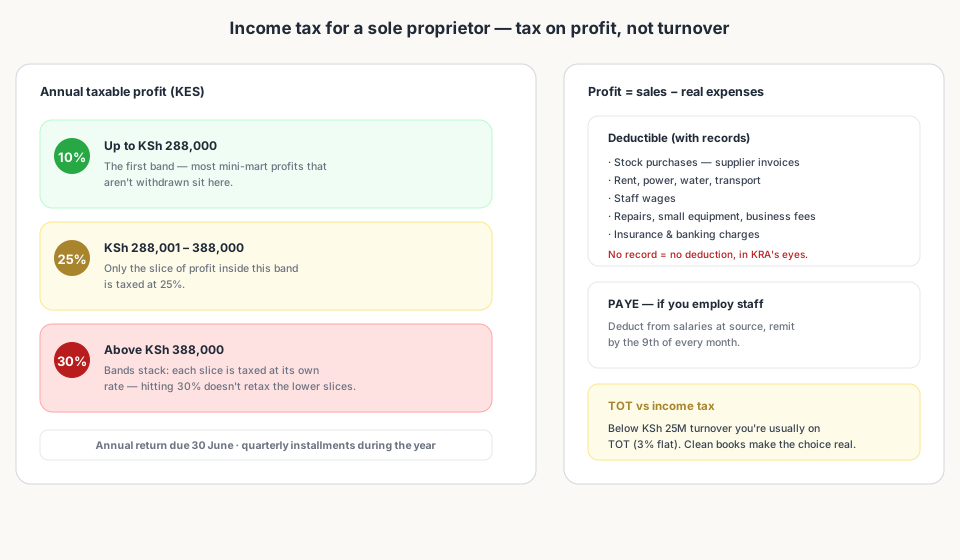
The word that matters is profit. Tax applies to what's left after your genuine business expenses — not to the full value of everything you sold. That single distinction is why two shops with identical sales can owe very different amounts of income tax, and why record-keeping is the whole game.
Expenses that reduce your taxable profit
- Stock — every purchase from your suppliers, evidenced by their invoices.
- Rent and utilities — the shop, power, water, and business phone costs.
- Staff wages — salaries of your employees (which also carry PAYE).
- Transport and delivery — moving stock from wholesaler to shelf.
- Repairs and small equipment — keeping the shop running.
- Business banking, insurance, and professional fees — accountant and licensing costs.
PAYE: the tax on your staff's salaries
The moment you employ someone, you become an employer in KRA's eyes. Register for PAYE, deduct it from each salary at source using the official bands, and remit it by the 9th of the following month. The personal relief makes most low-wage retail staff pay little or no PAYE — but the deduction, remittance, and monthly return still need to happen.
The annual routine
- Quarterly installment tax through the year if your expected annual tax is above the threshold — four installments that stop June being a shock.
- Annual income tax return on iTax by 30 June for the previous calendar year.
- PAYE monthly: deduct, remit by the 9th, file the return.
- Keep your profit and loss honest all year — the return is a summary of records you already have.
Income tax vs. turnover tax
If you're in the KSh 1–25 million turnover band, you're likely on turnover tax (3% of gross) rather than income tax on profits. Some shops choose income tax because their margins are thin and expenses are high — a conversation worth having with an accountant once your books are clean. The numbers are only comparable when the records are real.
- Turnover Tax (TOT) in Kenya: Who Pays, the Rate, and How to FileThe 3% alternative for shops in the KSh 1–25M band.
- Record-Keeping and KRA Penalties: What Kenyan Shop Owners Must Keep (and Avoid)The records that make income tax painless — and the penalties for not having them.
- Taxes for Mini-Marts in Kenya: The Complete eTIMS & KRA GuideThe pillar guide — every tax mapped in one place.
Frequently asked questions
How much income tax does a shop owner in Kenya pay?
Sole proprietors pay tax on their business profits at the individual rates: 10% up to KSh 288,000 a year, 25% on the next band up to KSh 388,000, and 30% above that. The rate applies to profit, not turnover — so legitimate expenses genuinely reduce what you owe.
What business expenses can I deduct?
Expenses incurred wholly and exclusively for the business: stock purchases, rent, power, water, transport and delivery, staff wages, repairs, and business-related insurance and banking charges. The rule is simple — every deduction needs a record, so invoices from suppliers and your own till records are the evidence.
When is the income tax return due in Kenya?
The annual income tax return is filed through iTax by 30 June following the end of the year (the tax year runs January to December). If your expected tax is significant, you also pay quarterly installment tax during the year rather than one painful lump in June.
Do I pay PAYE as a mini-mart owner?
If you employ staff — cashiers, shop attendants, stock clerks — yes. You register for PAYE as an employer, deduct it from each employee's salary at source, and remit it to KRA by the 9th of the following month. It's a withholding tax: the money comes out of salaries, and your job is to pass it on.
Related articles
- Tax & complianceTaxes for Mini-Marts in Kenya: The Complete eTIMS & KRA GuideEverything a mini-mart owner in Kenya needs to know about tax — eTIMS, VAT, turnover tax, income tax, PAYE, excise, records, and penalties — and how the right till keeps it manageable.
- Tax & complianceTurnover Tax (TOT) in Kenya: Who Pays, the Rate, and How to FileTurnover tax explained for Kenyan shop owners — the KSh 1–25 million range, the 3% rate, the monthly filing routine, and how TOT relates to income tax and VAT.
- Tax & complianceVAT for Small Businesses in Kenya: Threshold, Rates & FilingWhen VAT registration is compulsory in Kenya, what the 16% applies to, why staples often owe little VAT, and the monthly return routine — explained for shop owners.
- Tax & complianceRecord-Keeping and KRA Penalties: What Kenyan Shop Owners Must Keep (and Avoid)What records a Kenyan shop must keep and for how long, the KRA penalty schedule for late returns and eTIMS violations, and why automatic records beat reconstruction.
- OperationsBuilding Systems for Your Mini-Mart: Hires, Roles, and Routines That Run Without YouHow to structure roles, scopes of work, and daily/weekly/monthly routines so a Kenyan mini-mart runs the same whether you're at the till or not.
Ready for a POS built for Kenya?
Start free on Kiosk.ke — barcode POS, native M-Pesa STK, offline sales, and an online storefront from one stock count.