Series 06
eTIMS & Taxes
Series 06
eTIMS & Taxes
Tax & compliance
What Is eTIMS in Kenya? The System Explained
eTIMS — KRA's Electronic Tax Invoice Management System — explained for shop owners: how invoices get authorized, who must use it, and the four ways to run it.
25 August 2026 · Kiosk
If you run a shop in Kenya and you've heard the letters eTIMS but never quite had them explained, this is the guide for you. eTIMS is KRA's Electronic Tax Invoice Management System — the way the taxman now sees what you sell, in real time, without ever walking into your shop.
It matters to you because it sits underneath nearly everything else in this tax series. Understand eTIMS and the rest of your tax life — turnover tax, VAT, records, audits — becomes clearer. So let's strip the jargon off it.
How eTIMS works, in one paragraph
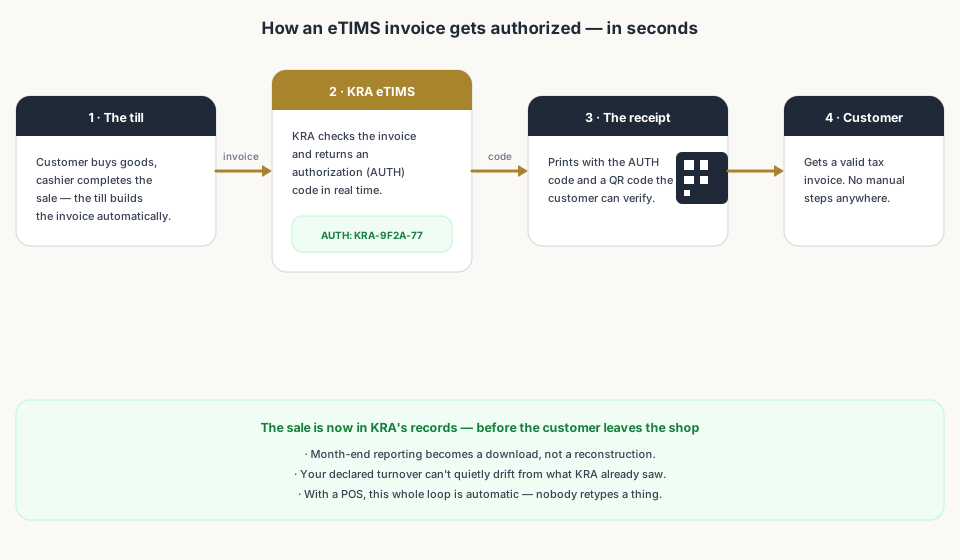
You make a sale and generate an invoice for it. The invoice goes to KRA's system, which checks it and hands back an authorization code — the AUTH code — in real time. The invoice now carries that code and a QR code, and the sale is logged in KRA's records. Customer happy, sale closed, and the taxman already knows. That's the whole loop.
The four ways to run eTIMS
- eTIMS Lite (web portal) — generate invoices in your browser. Fine for low volume, painful for a busy counter.
- eTIMS Mobile App — invoicing from your phone. Great for traders on the move, not built for checkout speed.
- eTIMS offline desktops (Lite/Standard) — KRA's desktop apps with a USB token that signs invoices. Workable, but still manual per invoice.
- POS / API integration — your till talks to eTIMS directly, so every sale gets an authorized invoice automatically. The only option that scales with a real shop floor.
The first three are manual — someone has to create an invoice per sale, which is why they suit low-volume traders. The fourth is automatic, which is why it suits shops. If your till generates the invoice the moment the sale closes, the AUTH code and QR code appear without anyone lifting a finger.
What eTIMS means for a mini-mart owner
- Every sale can (and should) produce an eTIMS-compliant invoice — even small cash sales, because KRA can now see your turnover directly.
- Your stock and your invoices should agree. An invoice trail that doesn't match your shelves is exactly the inconsistency an audit looks for.
- If a customer asks for a receipt, the invoice you hand them carries KRA's authorization — which is why it's also better for customer trust.
- Month-end reporting stops being a reconstruction. The data is already with KRA; you're just confirming it.
Where eTIMS fits in your overall tax picture
eTIMS is not a tax you pay — it's the invoice system under every tax you pay. Your turnover tax and VAT are calculated from the sales you report, and eTIMS is what makes that reporting verifiable. That's why the penalty for dodging it is serious, and why the smart play is to make it automatic.
- Taxes for Mini-Marts in Kenya: The Complete eTIMS & KRA GuideThe pillar guide — every tax mapped in one place.
- How to Register for eTIMS in Kenya: Step-by-StepFrom iTax login to your first authorized invoice.
- eTIMS and Your POS: How the Right Till Keeps You KRA-ReadyHow integration works and what to look for in a till.
Frequently asked questions
What does eTIMS stand for?
Electronic Tax Invoice Management System. It's KRA's system for generating, authorizing, and tracking electronic tax invoices — the modern replacement for the old ETR (Electronic Tax Register) machines.
Is eTIMS free to use?
The eTIMS web portal and mobile app are free to use for invoicing. KRA does not charge for onboarding to the system itself; the practical costs are your time and any device you choose, like a USB token for desktop signing or a POS system that integrates with eTIMS.
Who must use eTIMS in Kenya?
Businesses required to issue tax invoices under KRA rules — in practice this means VAT-registered businesses, and KRA has been enforcing eTIMS across retail broadly. Even smaller shops find that issuing eTIMS-compliant invoices through a POS keeps them ahead of enforcement and makes month-end reporting trivial.
Is eTIMS replacing ETR machines?
Yes. KRA has been phasing out ETR machines in favor of eTIMS, which streams invoice data to KRA in real time instead of relying on monthly downloads from a sealed register. If you still run an ETR, the migration path is to onboard to eTIMS through one of its four methods.
Related articles
- Tax & complianceTaxes for Mini-Marts in Kenya: The Complete eTIMS & KRA GuideEverything a mini-mart owner in Kenya needs to know about tax — eTIMS, VAT, turnover tax, income tax, PAYE, excise, records, and penalties — and how the right till keeps it manageable.
- Tax & complianceHow to Register for eTIMS in Kenya: Step-by-StepHow to onboard to eTIMS in Kenya — the iTax steps, the four onboarding methods, what a USB token is for, and how a POS handles the whole thing for you.
- Tax & complianceeTIMS and Your POS: How the Right Till Keeps You KRA-ReadyHow eTIMS/POS integration works in Kenya — AUTH codes per sale, offline queues, OSCU/VSCU, and what to look for in a till that makes KRA compliance automatic.
- Tax & complianceRecord-Keeping and KRA Penalties: What Kenyan Shop Owners Must Keep (and Avoid)What records a Kenyan shop must keep and for how long, the KRA penalty schedule for late returns and eTIMS violations, and why automatic records beat reconstruction.
- Tax & complianceTurnover Tax (TOT) in Kenya: Who Pays, the Rate, and How to FileTurnover tax explained for Kenyan shop owners — the KSh 1–25 million range, the 3% rate, the monthly filing routine, and how TOT relates to income tax and VAT.
Ready for a POS built for Kenya?
Start free on Kiosk.ke — barcode POS, native M-Pesa STK, offline sales, and an online storefront from one stock count.