
Series 06
eTIMS & Taxes
Series 06
eTIMS & Taxes
Tax & compliance
Turnover Tax (TOT) in Kenya: Who Pays, the Rate, and How to File
Turnover tax explained for Kenyan shop owners — the KSh 1–25 million range, the 3% rate, the monthly filing routine, and how TOT relates to income tax and VAT.
25 August 2026 · Kiosk
Turnover tax — TOT — is the tax most Kenyan mini-marts actually live with, and yet it's the one owners understand least. It's also one of the simplest taxes in the country once you see it clearly.
Who TOT applies to
TOT applies to businesses whose annual turnover is between KSh 1 million and KSh 25 million. That's a wide band on purpose: it captures the small trader who has outgrown the very bottom, and the mid-size shop that hasn't graduated to full income tax. The vast majority of single-branch mini-marts live in this range, which makes TOT the default tax for the neighbourhood shop.
Below KSh 1 million you're in the micro range where tax obligations are minimal; above KSh 25 million you're out of TOT and onto income tax on your actual profits. And note: TOT and VAT are not either/or. Above KSh 8 million of annual turnover you can be on TOT for income purposes and VAT-registered at the same time.
The rate: 3% of gross turnover
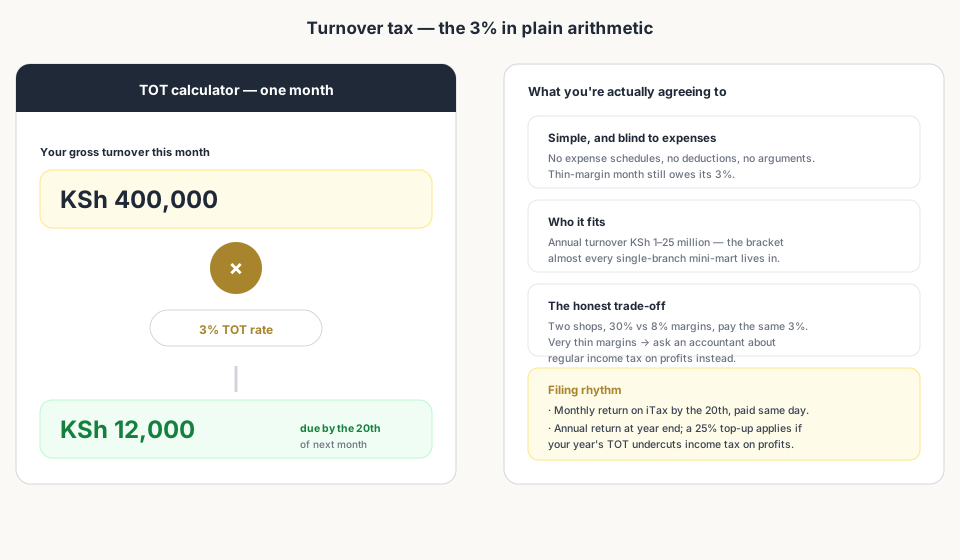
The rate is a flat 3% of gross turnover — what you sold, before any expenses. No expense schedules, no deductions, no allowances. The math is brutal in its simplicity: KSh 100,000 of sales is KSh 3,000 of TOT. KSh 500,000 of sales is KSh 15,000.
That's the honest trade-off of TOT: it's cheap to administer but blind to thin margins. Two shops, one with 30% margins and one with 8%, pay the same 3% on the same turnover. If your margins are genuinely thin, ask your accountant whether regular income tax on profits would leave you better off — TOT offers a year-end option to top up if your annual turnover tax undercuts what income tax would have been.
The filing routine
- File the monthly TOT return on iTax by the 20th of the following month.
- Pay the 3% the same day — the return and payment go together.
- At year end, file the annual TOT return; a 25% top-up applies if your total TOT for the year is less than 25% of what income tax on your profits would have been.
- Keep your sales records complete — TOT is calculated from what you declare, and eTIMS is how KRA checks.
TOT vs. income tax vs. VAT — the one-line version
| Tax | Applies when | Charged on | Rate |
|---|---|---|---|
| Turnover tax (TOT) | Turnover KSh 1M–25M | Gross turnover | 3% |
| Income tax | Turnover above KSh 25M (or opted in) | Profits | 10–30% |
| VAT | Taxable turnover above KSh 8M | Taxable supplies | 16% (standard) |
- Income Tax for Shop Owners in Kenya: Sole Proprietors, PAYE & FilingWhat happens above the TOT band, and how profits are taxed.
- VAT for Small Businesses in Kenya: Threshold, Rates & FilingThe separate obligation that kicks in at KSh 8 million.
- Taxes for Mini-Marts in Kenya: The Complete eTIMS & KRA GuideThe pillar guide — every tax mapped in one place.
Frequently asked questions
What is the turnover tax rate in Kenya?
Turnover tax is 3% of gross turnover for businesses with annual turnover between KSh 1 million and KSh 25 million. It was raised from 1% (and the range widened from KSh 5 million) by the Finance Act 2023. It's charged on what you sell, not on your profit.
Do mini-marts pay turnover tax?
Most do. A typical mini-mart turning over between KSh 1 million and KSh 25 million a year sits squarely in the TOT bracket — that's roughly KSh 3,000 of TOT for every KSh 100,000 of sales. Above KSh 25 million you move to regular income tax on profits, and above KSh 8 million VAT registration also kicks in.
When is turnover tax due in Kenya?
TOT is filed and paid monthly through iTax by the 20th of the following month — the same monthly rhythm as VAT. There's also an annual turnover tax return and a 25% top-up option at year end if your annual TOT falls short of what income tax would have been.
Can I claim expenses against turnover tax?
No — that's the trade-off. TOT is a flat percentage of gross turnover, so expenses don't reduce it. The simplicity (no expense schedules, no arguments with KRA about deductions) is the point. If your profit margins are very thin, regular income tax on profits might work out cheaper — that's a conversation for your accountant.
Related articles
- Tax & complianceTaxes for Mini-Marts in Kenya: The Complete eTIMS & KRA GuideEverything a mini-mart owner in Kenya needs to know about tax — eTIMS, VAT, turnover tax, income tax, PAYE, excise, records, and penalties — and how the right till keeps it manageable.
- Tax & complianceVAT for Small Businesses in Kenya: Threshold, Rates & FilingWhen VAT registration is compulsory in Kenya, what the 16% applies to, why staples often owe little VAT, and the monthly return routine — explained for shop owners.
- Tax & complianceIncome Tax for Shop Owners in Kenya: Sole Proprietors, PAYE & FilingHow income tax works for Kenyan shop owners — the 10/25/30% tax bands, what counts as a deductible expense, PAYE for staff, and the 30 June annual return.
- Tax & complianceWhat Is eTIMS in Kenya? The System ExplainedeTIMS — KRA's Electronic Tax Invoice Management System — explained for shop owners: how invoices get authorized, who must use it, and the four ways to run it.
- Tax & complianceRecord-Keeping and KRA Penalties: What Kenyan Shop Owners Must Keep (and Avoid)What records a Kenyan shop must keep and for how long, the KRA penalty schedule for late returns and eTIMS violations, and why automatic records beat reconstruction.
Ready for a POS built for Kenya?
Start free on Kiosk.ke — barcode POS, native M-Pesa STK, offline sales, and an online storefront from one stock count.